
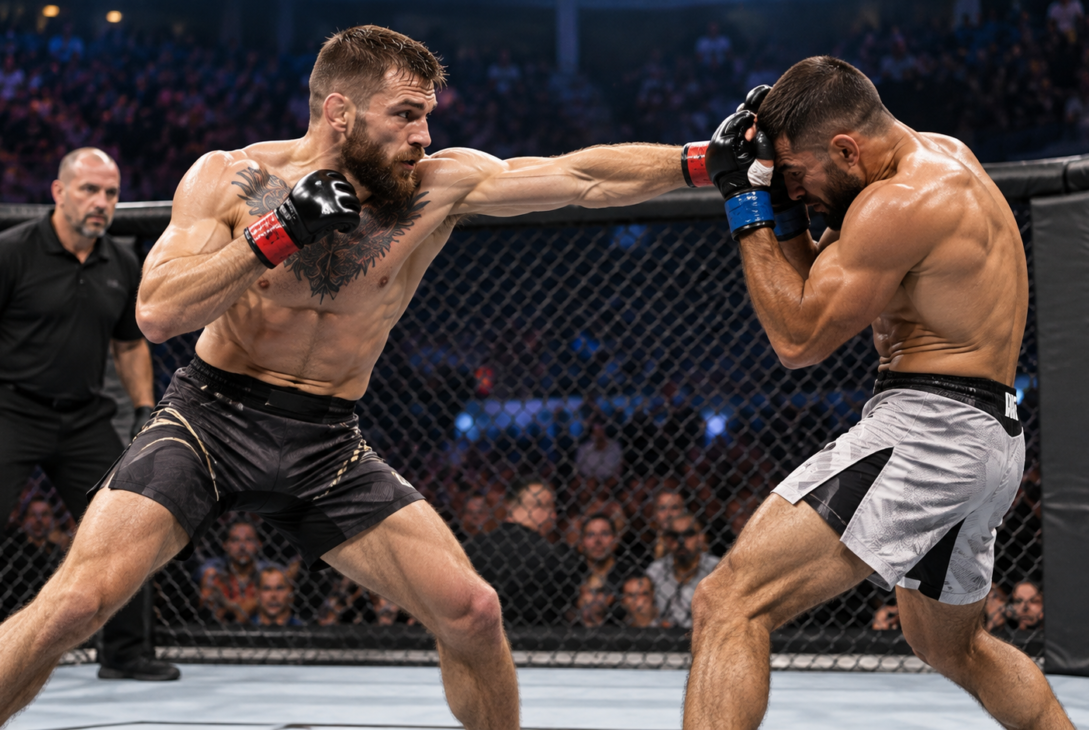
The UFC is the world’s most famous mixed martial arts organization. UFC fighters use a combination of boxing, kickboxing, wrestling, Brazilian jiu-jitsu, judo, and other combat sports to defeat their opponents.
Unlike boxing, where fighters mainly use punches, mixed martial arts allows both striking and grappling. Fighters can punch, kick, wrestle, take opponents to the ground, attempt submissions, and control positions.
However, the UFC is not a no-rules fight. Every bout is governed by the Unified Rules of Mixed Martial Arts, which are designed to protect fighters and create fair competition.
How does a UFC fight work?
Two fighters compete inside the UFC Octagon. A fight can end in several ways:
- Knockout
- Technical knockout
- Submission
- Judges’ decision
- Disqualification
- No contest
- Doctor or referee stoppage
The objective is to finish the opponent or win more rounds on the judges’ scorecards.
Most UFC fights are scheduled for three rounds. Main events and championship fights are usually scheduled for five rounds. Each round lasts five minutes, with a one-minute break between rounds.
A three-round fight can last up to 15 minutes. A five-round fight can last up to 25 minutes.
UFC weight classes explained
Weight classes help create fairer matchups by placing fighters with similar body weights against one another.
Men’s UFC weight classes
- Flyweight: Up to 125 pounds
- Bantamweight: Up to 135 pounds
- Featherweight: Up to 145 pounds
- Lightweight: Up to 155 pounds
- Welterweight: Up to 170 pounds
- Middleweight: Up to 185 pounds
- Light heavyweight: Up to 205 pounds
- Heavyweight: Up to 265 pounds
Women’s UFC weight classes
- Strawweight: Up to 115 pounds
- Flyweight: Up to 125 pounds
- Bantamweight: Up to 135 pounds
- Featherweight: Up to 145 pounds
The UFC also sometimes books catchweight fights. A catchweight fight takes place at an agreed weight that does not match the normal limit of a division.
Championship fights usually require fighters to meet the exact weight limit. Non-title fights may have a small allowance, depending on the division and the athletic commission overseeing the event.
The official UFC division structure includes divisions from strawweight through heavyweight.
What techniques are legal in the UFC?
UFC fighters may use many different techniques, including:
- Punches to the head and body
- Kicks to the legs, body, and head
- Knees in legal situations
- Takedowns
- Throws
- Wrestling control
- Ground-and-pound strikes
- Chokes
- Joint locks
- Position changes and reversals
A fighter may win without throwing a single knockout punch. For example, a fighter can control an opponent on the ground and finish the fight with a choke or arm lock.
Successful grappling includes takedowns, reversals, submission attempts, and gaining effective positions. Striking and grappling are both important parts of judging.
What actions are illegal in UFC fights?
Some techniques are prohibited because they create an unfair advantage or unnecessary danger.
Common UFC fouls include:
- Eye gouging
- Biting
- Hair pulling
- Spitting
- Headbutting
- Strikes to the back of the head
- Attacks to the spine
- Throat strikes
- Groin attacks
- Holding the fence
- Holding an opponent’s gloves or shorts
- Small-joint manipulation
- Stomping a grounded opponent
- Kneeing or kicking the head of a grounded opponent
- Attacking an opponent after the bell
- Ignoring the referee’s instructions
A foul may lead to a warning, a point deduction, a disqualification, or a no contest. The referee is responsible for identifying and penalizing fouls.
How UFC scoring works
If a fight goes the distance, three judges score the bout. Judges score each round separately using the 10-Point Must System.
Normally:
- The round winner receives 10 points.
- The losing fighter receives 9 points or fewer.
- A clearly even round may be scored 10-10.
- A dominant round may be scored 10-8.
- An extremely one-sided round can be scored 10-7.
Modern MMA judging gives the highest priority to damage. Judges look at how much a fighter’s legal attacks reduce the opponent’s ability or willingness to continue.
Judges also consider:
- Damage: Effective punches, kicks, knockdowns, submission attempts, and injuries.
- Dominance: Controlling positions and forcing the opponent to defend.
- Duration: How long a fighter maintains effective offense or control.
Effective striking and effective grappling are judged by their results. Simply holding an opponent down without creating damage or meaningful offense is not automatically enough to win a round.
A 10-9 round usually means one fighter performed better. A 10-8 round often involves significant damage or sustained dominance that nearly finishes the fight.
How can a UFC fight end?
Knockout
A knockout, or KO, occurs when a fighter is rendered unconscious by a legal strike.
Technical knockout
A technical knockout, or TKO, happens when the referee, doctor, or fighter’s corner stops the fight because continuing would be unsafe.
Submission
A submission occurs when a fighter taps the opponent or verbally submits because of a choke or joint lock.
A submission can also happen when a fighter becomes unconscious from a choke and the referee stops the fight.
Decision
If all scheduled rounds are completed, the judges decide the winner. A decision may be unanimous, split, or majority.
- Unanimous decision: All judges choose the same winner.
- Split decision: Two judges choose one fighter, while one judge chooses the opponent.
- Majority decision: Two judges choose one fighter, while one judge scores the fight as a draw.
Draw
A fight can end in a draw when the judges’ total scores are equal or when the scoring results produce a specific type of draw.
No contest
A no contest may be declared when a fight cannot be officially judged because of an accidental foul, illegal action, or another unusual circumstance.
What do UFC rankings mean?
UFC rankings show how fighters are positioned within their divisions. Ranked fighters are usually listed from No. 1 through No. 15.
The champion is listed separately and is not normally included as the No. 1-ranked contender. The fighter ranked No. 1 is usually considered the leading contender, although rankings do not automatically guarantee a title fight.
The UFC also publishes pound-for-pound rankings. These rankings compare fighters from different weight classes based on their overall ability and achievements.
Rankings can change after a major win or loss. A fighter can move upward by defeating a higher-ranked opponent. However, title opportunities also depend on activity, timing, injuries, division needs, popularity, and UFC matchmaking decisions.
Rankings should therefore be viewed as an important guide, not an automatic ladder.
How UFC championship fights work
A UFC championship fight is normally scheduled for five rounds of five minutes. The fighter who wins becomes the champion, while the losing champion may receive an immediate rematch depending on the circumstances.
A champion can lose the title by knockout, submission, decision, disqualification, or another official result. A title may also become vacant if the champion cannot defend it or leaves the division.
If a champion misses weight, the fight may still happen, but the title situation can change. In some cases, only one fighter may be eligible to win the championship.
Final thoughts
The UFC combines striking, wrestling, grappling, fitness, and strategy. A fighter may win by landing powerful strikes, controlling the ground, forcing a submission, or earning the judges’ decision.
Understanding weight classes helps you compare fighters fairly. Knowing the scoring system explains why control alone may not win a round. Learning the rankings makes it easier to understand title opportunities and championship matchups.
The most important idea is simple: UFC fighters must use effective legal offense while avoiding fouls. The fighter who finishes the opponent or wins the most rounds becomes the victor.