
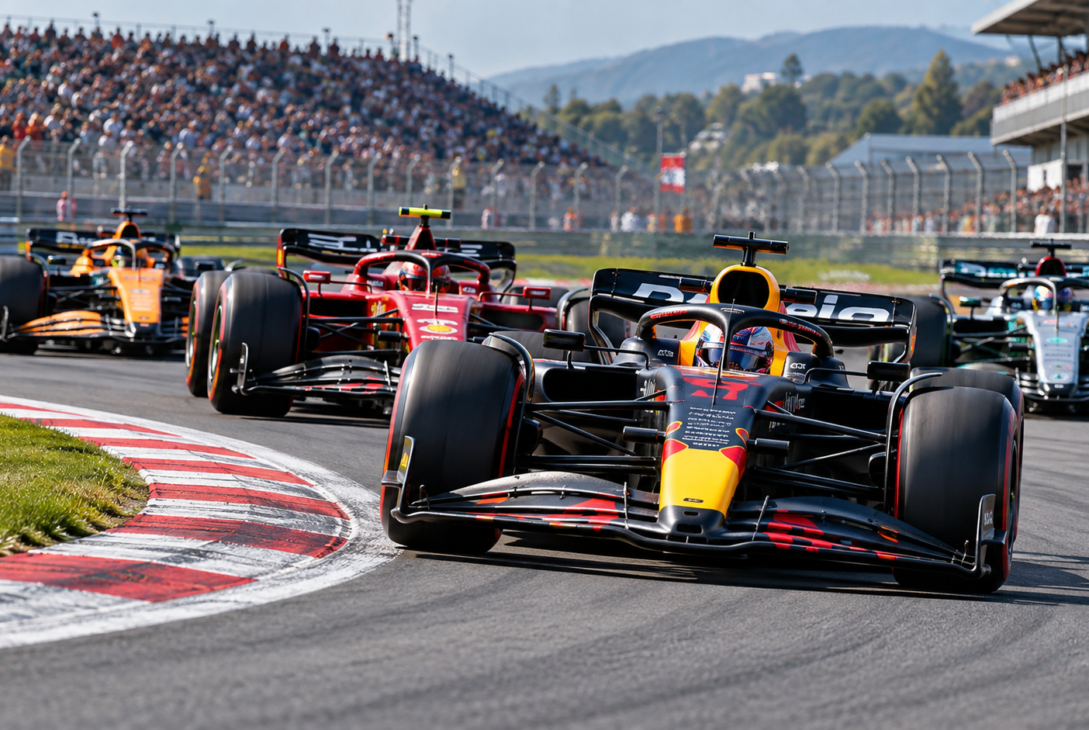
Formula 1, commonly known as F1, is the highest level of international single-seater motor racing. Drivers compete in high-performance cars designed and operated by professional teams. Every race is a combination of speed, strategy, technology, tyre management, pit stops, and driver skill.
The goal is simple: complete the required race distance faster than every other driver. However, winning a Formula 1 championship requires consistent performance throughout the entire season.
How does a Formula 1 race work?
A Formula 1 race is called a Grand Prix. Each Grand Prix takes place on a specially designed circuit or a temporary street circuit.
Most races cover a minimum distance of approximately 305 kilometres. The number of laps depends on the length of the circuit. Shorter circuits require more laps, while longer circuits require fewer laps.
The race usually lasts no more than two hours of racing time. However, safety-car periods, red flags, weather, or accidents can make the entire event last longer.
Before the race starts, drivers complete a formation lap. They then return to their grid positions. Five red lights appear above the track, and when all lights go out, the race begins.
The driver who crosses the finish line first is normally declared the winner, although penalties or post-race investigations can change the final result.
How does an F1 race weekend work?
A standard Formula 1 weekend usually takes place from Friday to Sunday.
Friday: Practice
Friday normally includes two practice sessions called Free Practice 1 and Free Practice 2.
Teams use practice to test their cars, understand tyre performance, adjust the setup, and collect data about the circuit. Practice results do not determine the starting order for the race.
Saturday: Final practice and qualifying
Saturday usually begins with Free Practice 3. This is the final opportunity for teams to prepare their cars before qualifying.
Qualifying determines the starting grid for Sunday’s race. It is divided into three stages:
- Q1: All drivers participate. The six slowest drivers are eliminated.
- Q2: The remaining drivers compete, and another six are eliminated.
- Q3: The final 10 drivers compete for the top 10 positions.
The fastest driver in Q3 starts from pole position, which is the first place on the starting grid.
Sunday: The Grand Prix
Sunday is the main race day. Drivers start in the order decided by qualifying, adjusted for any penalties.
They then compete over the scheduled number of laps. Drivers must manage their tyres, fuel, brakes, traffic, and race strategy while trying to finish as high as possible.
How does F1 scoring work?
Formula 1 awards championship points to the top 10 finishers in a Grand Prix.
| Position | Points |
|---|---|
| 1st | 25 |
| 2nd | 18 |
| 3rd | 15 |
| 4th | 12 |
| 5th | 10 |
| 6th | 8 |
| 7th | 6 |
| 8th | 4 |
| 9th | 2 |
| 10th | 1 |
The driver with the most points at the end of the season wins the Drivers’ Championship.
There is also a Constructors’ Championship. Each team has two cars, and the points earned by both drivers are added together. The team with the highest total wins the Constructors’ Championship.
What is an F1 Sprint?
Some Formula 1 events include a Sprint weekend. An F1 Sprint is a shorter race of approximately 100 kilometres and usually lasts around 30 minutes.
Sprint weekends have a different schedule:
- Friday includes one practice session.
- Sprint Qualifying takes place on Friday.
- The Sprint race takes place on Saturday.
- Qualifying for the main Grand Prix takes place later on Saturday.
- The Grand Prix remains the main race on Sunday.
Sprint points are awarded to the top eight finishers:
| Sprint Position | Points |
|---|---|
| 1st | 8 |
| 2nd | 7 |
| 3rd | 6 |
| 4th | 5 |
| 5th | 4 |
| 6th | 3 |
| 7th | 2 |
| 8th | 1 |
The Sprint result normally does not decide the starting grid for Sunday’s Grand Prix. A separate qualifying session sets the Grand Prix grid.
How do tyres and pit stops work?
Tyres are one of the most important parts of Formula 1 strategy. Different tyre compounds provide different levels of grip and durability.
Softer tyres are usually faster but wear out more quickly. Harder tyres generally last longer but may be slower. Intermediate and wet-weather tyres are used when the track is damp or wet.
During a pit stop, the driver enters the pit lane so the team can change tyres or repair the car. A well-organized pit stop can take only a few seconds, but the driver also loses time while travelling through the pit lane.
Teams decide when to pit based on tyre wear, weather, traffic, safety cars, and the position of rival drivers.
What are safety cars and red flags?
A Safety Car is used when an accident or danger makes normal racing unsafe. The Safety Car leads the drivers around the circuit at a reduced speed, and overtaking is restricted.
A Virtual Safety Car, or VSC, requires drivers to slow down to a controlled speed without grouping behind a physical Safety Car.
A red flag stops the session or race completely. It may be shown because of a major accident, dangerous weather, debris, or unsafe track conditions.
Common F1 penalties
Drivers and teams can receive penalties for breaking the rules.
A time penalty may add five or 10 seconds to a driver’s race. The driver can serve it during a pit stop, or the time may be added to their final result.
A drive-through penalty requires the driver to pass through the pit lane without stopping.
A stop-and-go penalty requires the driver to stop in the pit lane for a specific amount of time.
A grid penalty moves a driver down the starting order at a future race. Drivers may also be penalized for exceeding component limits, causing collisions, ignoring flags, or repeatedly exceeding track limits.
Final thoughts
Formula 1 is more than a contest of speed. The winning driver and team must combine fast driving, reliable engineering, intelligent strategy, effective pit stops, and careful tyre management.
Drivers compete for individual championship points, while teams compete for the Constructors’ Championship. Once you understand qualifying, scoring, tyres, pit stops, safety cars, and penalties, following Formula 1 becomes much easier and more exciting.