
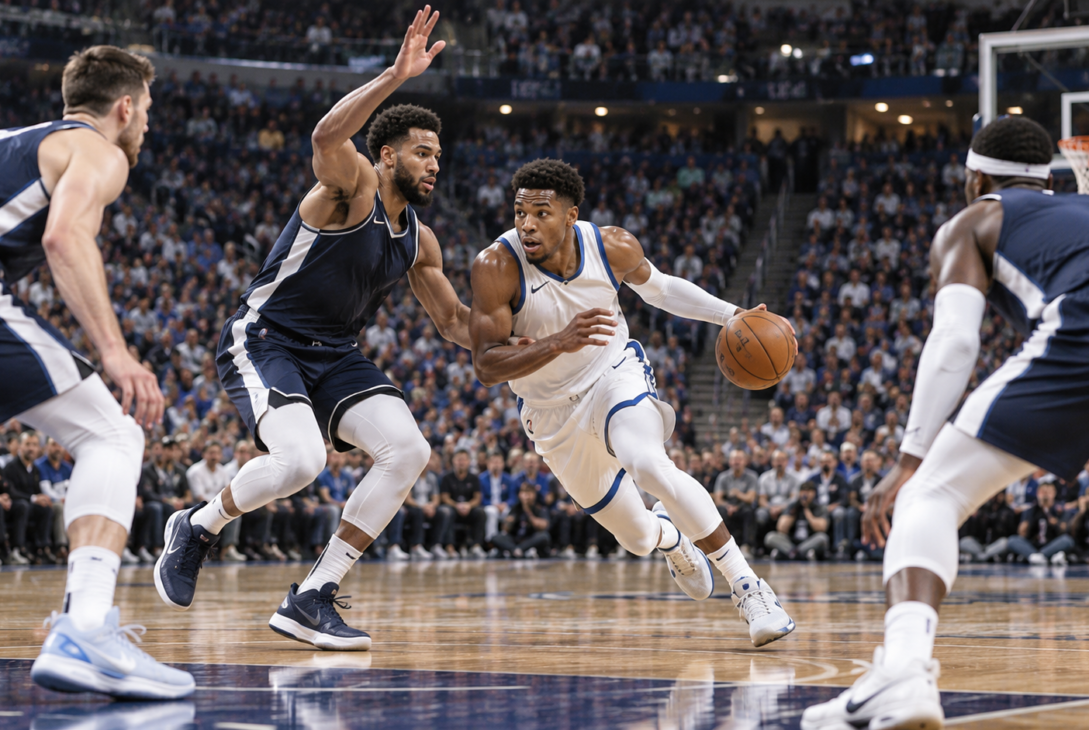
The NBA is a professional basketball league in which 30 teams compete through a regular season and postseason tournament. Every game is a contest between five players on the court for each team, with the objective of scoring more points than the opponent before time runs out.
This beginner-friendly guide explains the NBA’s teams, basketball rules, scoring system, season format, standings, Play-In Tournament, playoffs, and NBA Finals.
What does NBA stand for?
NBA stands for the National Basketball Association. The league has 30 teams divided equally between the Eastern Conference and Western Conference. Each conference contains 15 teams and is divided into three divisions.
The NBA is the top professional men’s basketball league in North America. Players from the United States and many other countries compete in the league, which has become one of the world’s most watched sports competitions.
How many teams are in the NBA?
The NBA has 30 teams. They are divided into two conferences:
Eastern Conference
The Eastern Conference contains three divisions:
•Atlantic Division: Boston Celtics, Brooklyn Nets, New York Knicks, Philadelphia 76ers, and Toronto Raptors.
•Central Division: Chicago Bulls, Cleveland Cavaliers, Detroit Pistons, Indiana Pacers, and Milwaukee Bucks.
•Southeast Division: Atlanta Hawks, Charlotte Hornets, Miami Heat, Orlando Magic, and Washington Wizards.
Western Conference
The Western Conference also contains three divisions:
•Northwest Division: Denver Nuggets, Minnesota Timberwolves, Oklahoma City Thunder, Portland Trail Blazers, and Utah Jazz.
•Pacific Division: Golden State Warriors, LA Clippers, Los Angeles Lakers, Phoenix Suns, and Sacramento Kings.
•Southwest Division: Dallas Mavericks, Houston Rockets, Memphis Grizzlies, New Orleans Pelicans, and San Antonio Spurs.
A team’s conference is especially important because teams qualify for the postseason through conference standings. A team primarily competes for position against the other teams in its conference, although it also plays teams from the opposite conference during the regular season.
How is an NBA team organized?
A team can have a maximum of 15 players on its standard roster, with 12 players active for a particular game according to the NBA’s official league information.
Only five players from each team are on the court during live play. The other players sit on the bench and may enter as substitutes. Coaches use substitutions to manage fatigue, match up against opponents, change tactics, or respond to injuries and foul trouble.
The five traditional basketball positions are:
•Point guard: Often organizes the offense and brings the ball up the court.
•Shooting guard: Commonly contributes perimeter shooting and scoring.
•Small forward: A versatile player who may score, defend, rebound, and handle the ball.
•Power forward: Often plays near the basket but may also shoot from outside.
•Center: Usually plays close to the basket and focuses on rebounding, interior defense, and finishing inside.
Modern NBA basketball is flexible. Players frequently handle several roles, so the position listed beside a player’s name does not always describe everything they do on the court.
The objective of an NBA game
The objective is simple: score more points than the opposing team by the end of the game.
A team scores by putting the ball through the opponent’s basket. Players can shoot from inside the three-point line, outside the three-point line, or from the free-throw line after certain fouls. The NBA’s official rules state that a successful field goal inside or on the three-point line is worth two points, a shot from outside the three-point line is worth three points, and a successful free throw is worth one point.
If the score is tied after the fourth quarter, the teams play a five-minute overtime period. Additional overtime periods are played if necessary until one team leads at the end of a period.
How long is an NBA game?
An NBA game has four quarters, and each quarter lasts 12 minutes. That gives 48 minutes of scheduled regulation playing time. The clock stops frequently for fouls, out-of-bounds plays, timeouts, substitutions, reviews, and other stoppages, so a complete broadcast usually lasts considerably longer than 48 minutes.
There is a longer halftime break between the second and third quarters. Shorter breaks occur between the first and second quarters, the third and fourth quarters, and before overtime.
How scoring works in the NBA
Two-point field goal
A shot made from inside the three-point line is worth two points. Layups, dunks, hook shots, mid-range jumpers, and many close-range attempts are two-point shots.
Three-point field goal
A shot is worth three points when the shooter releases it from outside the three-point line. The player must be outside the line at the start of the attempt. A player may land inside the line after releasing the ball and still receive three points, provided the shot was released legally.
Free throw
A successful free throw is worth one point. Free throws are uncontested attempts taken from behind the free-throw line. They are awarded after certain defensive fouls, shooting fouls, technical fouls, and other penalty situations.
And-one play
An “and-one” occurs when a player makes a field goal despite being fouled during the shooting action and then receives one additional free throw. A successful two-point shot plus the free throw can produce three points on the same play. A successful three-point shot plus the free throw can produce four.
The 24-second shot clock
The NBA uses a 24-second shot clock to keep the game moving. Once a team gains possession, it must attempt a field goal before the shot clock expires. For the attempt to count, the ball must leave the shooter’s hand before the clock reaches zero and then contact the basket ring.
If the team fails to attempt a legal shot in time, officials call a shot-clock violation and the opposing team receives possession.
After an offensive rebound, the shot clock is generally reset to 14 seconds when the relevant conditions apply. After a change of possession, it is normally reset to 24 seconds. The precise reset depends on what happened immediately before the stoppage.
Moving the ball up the court
A team usually advances the ball by passing or dribbling. The team has eight seconds to move the ball from its backcourt into the frontcourt. Once a team establishes possession in the frontcourt, it cannot normally return the ball to the backcourt and be the first team to touch it there.
A dribble occurs when a player throws or taps the ball to the floor while controlling it. A player may not stop the dribble and then begin a second dribble unless another player has touched the ball or a permitted event has occurred.
A traveling violation occurs when a player moves illegally while controlling the ball. In simple terms, a player who gathers the ball must establish a legal pivot foot and may not take additional steps beyond what the rules permit before passing or shooting.
Common NBA violations
Violations are rule breaches that generally result in the other team receiving the ball. They are different from personal fouls because they usually do not involve illegal physical contact.
Traveling
Traveling happens when a player takes illegal steps while holding the ball. It can occur after a player gathers the ball, changes direction, or attempts to begin or end a dribble.
Double dribble
A double dribble happens when a player ends a dribble and then starts another dribble without a legal reason. It can also occur when a player dribbles with both hands at the same time.
Carrying or palming
A player cannot place their hand underneath the ball and continue the dribble in a way that gives them an unfair advantage. This is commonly called carrying or palming.
Out of bounds
The ball is out of bounds when it touches the boundary line, the floor outside the boundary, or a player who is touching the boundary. The opposing team then receives the ball for a throw-in.
Three-second violation
An offensive player cannot remain in the opponent’s restricted area for longer than the permitted time while their team controls the ball in the frontcourt. The rule prevents an offensive player from standing beside the basket continuously.
Eight-second violation
The offense must advance the ball from the backcourt into the frontcourt within eight seconds.
Shot-clock violation
The offense must attempt a legal field goal before the 24-second clock expires. If it fails, possession changes.
Fouls in the NBA
A foul generally involves illegal physical contact or unsportsmanlike behavior. The NBA defines a common personal foul as illegal contact with an opponent while the ball is live. The league also recognizes offensive fouls, technical fouls, loose-ball fouls, flagrant fouls, and other categories.
Personal foul
A personal foul can involve holding, pushing, charging into an opponent, impeding an opponent’s movement, or making illegal contact while defending or attacking.
If a defender fouls a shooter during an unsuccessful two-point attempt, the shooter normally receives two free throws. If the foul occurs during an unsuccessful three-point attempt, the shooter normally receives three. If the shot goes in, the basket counts and the shooter normally receives one additional free throw.
Offensive foul
An offensive foul is committed by the team with the ball. A common example is a charge, when an offensive player makes illegal contact with a defender who has established a legal guarding position.
An offensive foul usually gives the other team possession and counts against the player’s personal foul total. It is not normally penalized with free throws unless a special rule applies.
Team fouls and the bonus
The NBA limits each team to four team fouls per regulation period before additional common-foul penalties apply. Once the penalty situation is in effect, the opponent can receive free throws for certain defensive fouls that would otherwise result only in an inbound pass.
The exact penalty depends on the quarter, the type of foul, whether the player was shooting, and other circumstances. This is why the broadcast displays team-foul totals and why late-quarter fouls can be strategically important.
Technical foul
A technical foul is generally associated with unsportsmanlike conduct or a rules violation that is not a standard illegal-contact foul. Excessive arguing, certain forms of delay, or inappropriate conduct can lead to a technical foul.
Flagrant foul
A flagrant foul involves unnecessary or excessive contact. Depending on the level of the foul, the penalty may include free throws, possession, and ejection.
What is a turnover?
A turnover occurs when a team loses possession before taking a successful shot. Turnovers can result from traveling, bad passes, steals, offensive fouls, out-of-bounds plays, shot-clock violations, or other mistakes.
A steal is credited when a defensive player directly causes the opponent to lose possession, such as by taking the ball from a dribbler or intercepting a pass.
Teams try to create turnovers on defense while protecting the ball on offense. A team that gives away fewer possessions may have a significant advantage even if both teams shoot similar percentages.
What are rebounds, assists, and blocks?
•Rebound: Gaining possession after a missed field goal or free throw. An offensive rebound is collected by the shooting team; a defensive rebound is collected by the other team.
•Assist: A pass that directly leads to a made field goal.
•Block: A defensive player legally deflects an opponent’s field-goal attempt.
•Steal: A defensive player takes or intercepts the ball and causes a change of possession.
•Turnover: A team loses possession before completing its offensive play.
These statistics help describe how a player contributes beyond scoring.
How the NBA regular season works
Each team plays 82 regular-season games. The schedule includes games against teams in its own conference and games against teams in the opposite conference. The goal is to finish the regular season with as many wins as possible and secure a strong position in the conference standings.
Standings are primarily based on winning percentage rather than simply the number of wins because teams play the same number of regular-season games but may have different records during the season. A team’s record might be written as 48–34, meaning 48 wins and 34 losses.
The regular season also determines home-court advantage. A higher-seeded team generally hosts more games in a playoff series than a lower-seeded opponent.
What are NBA standings and seeds?
A standing shows where a team ranks in its conference based on its record and applicable tiebreaking procedures.
A seed is a team’s postseason position. The No. 1 seed is the highest-ranked team in a conference, while the No. 8 seed is lower in the bracket.
The division titles are part of the league’s organizational structure, but postseason seeding is determined by conference standings. Winning a division does not automatically guarantee a particular playoff seed.
How the NBA Play-In Tournament works
The NBA Play-In Tournament determines the seventh and eighth playoff seeds in each conference.
The teams that finish Nos. 1–6 in each conference qualify directly for the playoffs. The teams that finish Nos. 7–10 enter the Play-In Tournament.
The format works as follows:
1.The No. 7 team hosts the No. 8 team. The winner becomes the No. 7 playoff seed. The loser receives another opportunity.
2.The No. 9 team hosts the No. 10 team. The winner continues in the Play-In Tournament, while the loser is eliminated.
3.The loser of the No. 7-versus-No. 8 game hosts the winner of the No. 9-versus-No. 10 game.
4.The winner of that final Play-In game becomes the No. 8 playoff seed.
This gives the seventh- and eighth-ranked teams an advantage because they have more than one opportunity to win a Play-In game. The ninth- and tenth-ranked teams must win two games to reach the playoffs.
How the NBA playoffs work
The playoffs are a conference-based tournament. Six teams from each conference qualify automatically, and two more teams from each conference enter through the Play-In Tournament. That creates eight playoff teams in the Eastern Conference and eight in the Western Conference.
Each playoff round is played as a best-of-seven series. The first team to win four games advances. A series can therefore finish in four, five, six, or seven games.
The usual playoff rounds are:
1.First Round: Eight teams in each conference become four.
2.Conference Semifinals: Four teams in each conference become two.
3.Conference Finals: The final two teams in each conference compete for the conference championship.
4.NBA Finals: The Eastern Conference champion plays the Western Conference champion.
The playoff bracket is arranged so that higher seeds play lower seeds in the opening round. Home-court advantage is usually awarded to the team with the better regular-season record, although the complete tiebreaking and scheduling rules are set by the NBA’s official regulations.
What are the NBA Finals?
The NBA Finals are the championship series between the Eastern Conference champion and the Western Conference champion. Like the earlier rounds, the Finals are a best-of-seven series. The first team to win four games becomes the NBA champion.
The team that wins the Finals receives the Larry O’Brien NBA Championship Trophy. The player judged to have made the biggest impact during the series receives the Bill Russell NBA Finals Most Valuable Player Award.
How to read an NBA box score
A box score records the main statistics from a game. A player’s line might look like:
28 points, 8 rebounds, 7 assists, 2 steals, 1 block, 3 turnovers
This means the player scored 28 points, collected eight rebounds, made seven final passes leading directly to baskets, recorded two steals, blocked one shot, and lost possession three times.
A team score such as 112–108 means the first team scored 112 points and the second team scored 108. The team with 112 wins.
Common team statistics include field-goal percentage, three-point percentage, free-throw percentage, rebounds, assists, turnovers, steals, blocks, and personal fouls.
A simple way to follow an NBA game
When watching an NBA game, begin with these five questions:
1.Which team has possession?
2.How much time remains in the quarter and on the shot clock?
3.What is the score difference?
4.How many team fouls have been committed in the quarter?
5.Which players are on the court, and are any important players in foul trouble?
The score difference tells you who is ahead. The shot clock tells you how long the offense has to create a shot. Team fouls indicate whether additional defensive fouls may produce free throws. Player fouls matter because a player who accumulates too many personal fouls can be disqualified from the game.
Final takeaway
The NBA combines a fast-paced game with a long league season and a structured postseason. The 30 teams play 82 regular-season games, compete for conference position, and then fight through the Play-In Tournament and best-of-seven playoff series for a place in the NBA Finals.
The essential rules are straightforward: score through two-point shots, three-point shots, and free throws; move the ball without traveling or committing other violations; attempt a shot before the 24-second clock expires; defend without illegal contact; and finish with more points than the opponent.