
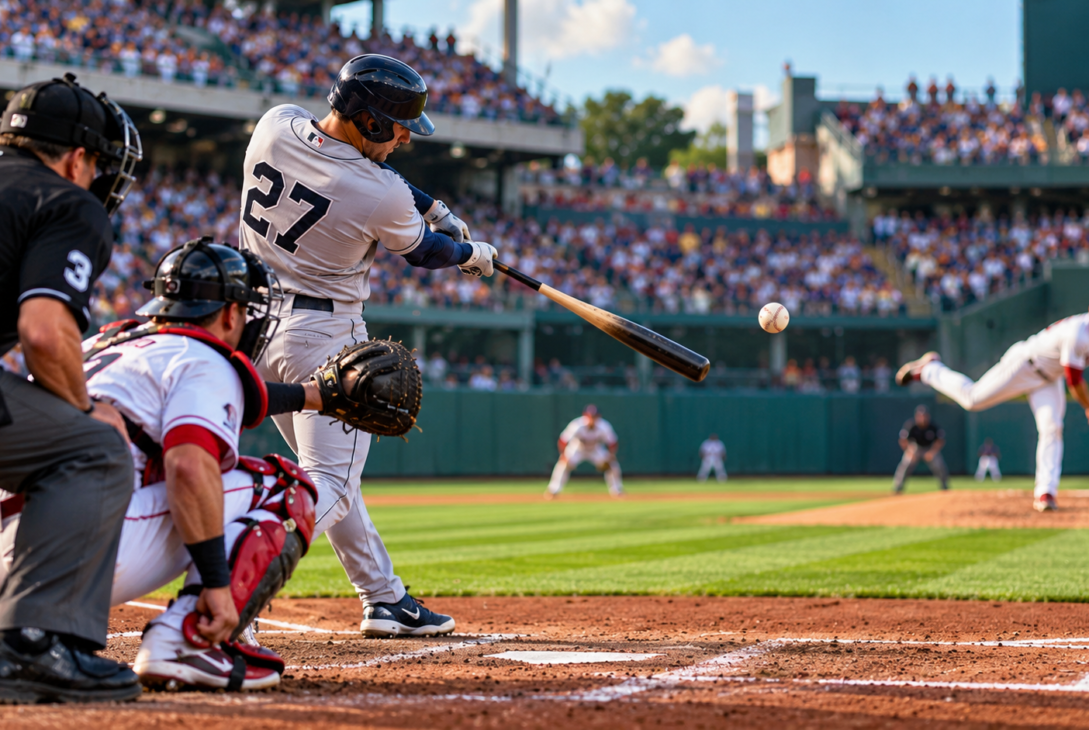
Baseball can look complicated when you first watch it. Players move around the field, pitchers throw different types of pitches, and the scoreboard displays numbers such as balls, strikes, outs, and innings.
The basic objective is simple:
One team tries to score runs while the other team tries to prevent them.
Teams take turns batting and fielding. The team with the most runs at the end of the game wins.
This beginner-friendly guide explains the most important baseball rules, including innings, strikes, balls, outs, hits, runs, home runs, and pitching.
How does baseball work?
A baseball game is played between two teams. One team bats while the other team fields.
The batting team tries to hit the ball and advance its runners around four bases:
- Home plate
- First base
- Second base
- Third base
A player scores one run by touching all four bases and returning safely to home plate.
The fielding team tries to record three outs. Once three outs are made, the teams switch roles.
What is an inning?
An inning is one complete turn for both teams.
Each inning has two halves:
- Top half: The visiting team bats.
- Bottom half: The home team bats.
The team that is batting tries to score runs. The team in the field tries to make three outs.
A standard professional baseball game has nine innings. If the score is tied after nine innings, the game continues into extra innings until one team wins.
If the home team is leading after the visiting team finishes batting in the ninth inning, the bottom half of the ninth inning may not be played because the home team already has enough runs to win.
What is an out?
An out removes a batter or baserunner from the current batting turn. Three outs end a team’s half-inning.
Common types of outs include:
Strikeout
A batter strikes out after receiving three strikes. The batter is usually out even if they do not swing at the third strike, provided the pitch is called a strike.
Flyout
A fielder catches a ball in the air before it touches the ground. The batter is out immediately.
Groundout
A batter hits the ball on the ground, and a fielder throws it to first base before the batter reaches safely.
Force out
A force out occurs when a runner is required to advance because the batter becomes a runner. A fielder can record the out by touching the base before the runner arrives.
Tag out
A fielder tags a runner with the ball or with a glove holding the ball while the runner is not safely touching a base.
Three outs end the batting team’s turn, regardless of how many runs have been scored during that half-inning.
What is a strike?
A strike is counted when:
- The batter swings and misses.
- The batter does not swing at a pitch that passes through the strike zone.
- The batter hits a foul ball, subject to specific rules.
- The batter fails to make a legal attempt in certain situations.
The strike zone is the area above home plate between the batter’s defined upper and lower limits. MLB describes the zone as extending from approximately the midpoint between the batter’s shoulders and the top of the uniform pants down to a point just below the kneecap.
The home-plate umpire normally calls balls and strikes after each pitch.
A batter is out after three strikes. This is called a strikeout.
What is a ball?
A ball is a pitch that does not enter the strike zone and is not swung at by the batter.
If a batter receives four balls during one plate appearance, the batter is awarded first base. This is called a walk or base on balls.
For example, if a pitcher throws four pitches outside the strike zone and the batter does not swing at them, the batter can walk to first base.
A walk can become especially important when runners are already on base. If first base is occupied, runners may be forced to advance.
What is the count?
The count shows the number of balls and strikes during a batter’s plate appearance.
The ball count is shown first, followed by the strike count.
Examples include:
- 0–0: No balls and no strikes.
- 1–2: One ball and two strikes.
- 3–2: Three balls and two strikes.
A 3–2 count is often called a full count because the next ball may result in a walk, while the next strike may result in a strikeout.
How are runs scored?
A team scores a run when a runner safely touches first base, second base, third base, and home plate in that order.
A run may be scored after:
- A hit
- A walk
- A sacrifice fly
- A fielder’s error
- A stolen base followed by another play
- A home run
The batting team can score more than one run on the same play. For example, if the bases are loaded and the batter hits a home run, four runs score. This is called a grand slam.
What are hits in baseball?
A hit occurs when a batter strikes the ball and reaches base safely without the help of a fielding error.
Common types of hits include:
- Single: The batter reaches first base.
- Double: The batter reaches second base.
- Triple: The batter reaches third base.
- Home run: The batter hits the ball out of the playing field in fair territory or safely completes the bases through an inside-the-park home run.
A home run usually allows the batter and all runners on base to score.
What is a foul ball?
A foul ball is a batted ball that lands outside the fair territory lines or first travels outside the required boundary.
A foul ball usually counts as a strike if the batter has fewer than two strikes. However, a foul ball normally does not create a third strike unless it is caught in the air or the batter makes a foul bunt with two strikes.
This rule allows batters with two strikes to continue fighting off pitches without automatically striking out every time they hit the ball foul.
What does the pitcher do?
The pitcher throws the ball toward home plate and tries to prevent the batter from reaching base.
Pitchers use different types of pitches, including:
- Fastballs
- Curveballs
- Sliders
- Changeups
- Cutters
- Splitters
A pitcher may try to throw the ball past the batter, create a swing and miss, or force the batter to hit the ball weakly toward a fielder.
The pitcher also tries to control baserunners. A runner may attempt to steal the next base while the pitcher is focused on the batter.
What is a home run?
A home run occurs when the batter hits a fair ball over the outfield boundary without it being caught. The batter and every runner on base score.
A home run with no runners on base is a solo home run. A home run with one runner on base produces two runs. A home run with two runners on base produces three runs. A home run with the bases loaded produces four runs and is called a grand slam.
How is a baseball game won?
The team with more runs after nine innings wins the game.
For example:
- Team A scores 5 runs.
- Team B scores 3 runs.
Team A wins 5–3.
If the score is tied after nine innings, the teams play extra innings. The first team to lead after a completed extra inning wins, subject to the league’s extra-inning rules.
Modern MLB rule features
Major League Baseball uses additional rules that affect the speed and strategy of the game. These include the pitch timer, limits on defensive shifts, larger bases, replay reviews, and designated hitters.
Beginning with the 2026 MLB season, players can challenge certain ball-and-strike calls through the Automated Ball-Strike Challenge System. Each team starts with two challenges, and successful challenges are retained.
These rules are designed to improve accuracy, encourage action, and keep the game moving while preserving the central structure of baseball.
Final thoughts
Baseball becomes much easier to understand when you focus on four numbers:
- Balls: Four balls usually produce a walk.
- Strikes: Three strikes produce a strikeout.
- Outs: Three outs end a team’s half-inning.
- Runs: The team with the most runs wins.
The batting team tries to reach base and score. The fielding team tries to record outs before runners cross home plate. Every pitch can change the count, every hit can create a scoring chance, and every out brings the inning closer to a change of possession.